Designing against decay
"If you assume that there is no hope, you guarantee that there will be no hope. If you assume that there is an instinct for freedom, that there are opportunities to change things, then there is a possibility that you can contribute to the making a better world." ~ Noam Chomsky
Most systems decay. Over time, they stop optimising for their original purpose and start preserving themselves for survival's sake [1]. This is a recurring bug in the source code of human coordination—a pattern you see on every second page of history. We are creatures of habit, and habitual thinking creates process inertia: layers of sediment that harden into their own gravitational pull. Having worked inside many such systems, I've learnt the reflex of cynicism at the mere thought of the "process hours" required to move anything an inch.
We see this almost everywhere. Paper deeds become PDFs; wax seals become e-signatures. Different wrappers though with the same assumptions. There is a natural resting point that feels "close enough" to the analogue original, and into that complacency creep embedded interests that leech nutrition from the whole. Complex systems exhibit frailty by inviting incredibly specialised rule-making.
Consider imperial China's civil service exam, the keju. On the surface it was a meritocratic funnel for capable minds, and many devoted their lives to mastering its intricacies. Yet its deeper, longer-lived purpose was to prolong central authority [2]. By making office depend on mastery of a narrow, arcane language instead of practical coordination, it channeled elite ambition into literati competition and reduced the odds of local dynamism or collective resistance. This resulted in political stability, administrative continuity—and economic stagnation. Relative to Europe after 1700, this equilibrium proved unproductive for the coordination required for industrialisation [3]. China's rapid change in governance strategy within the last few decades and especially after WTO accession in 2001—underlines to what degree institutional design constrains or nourishes GDP growth.
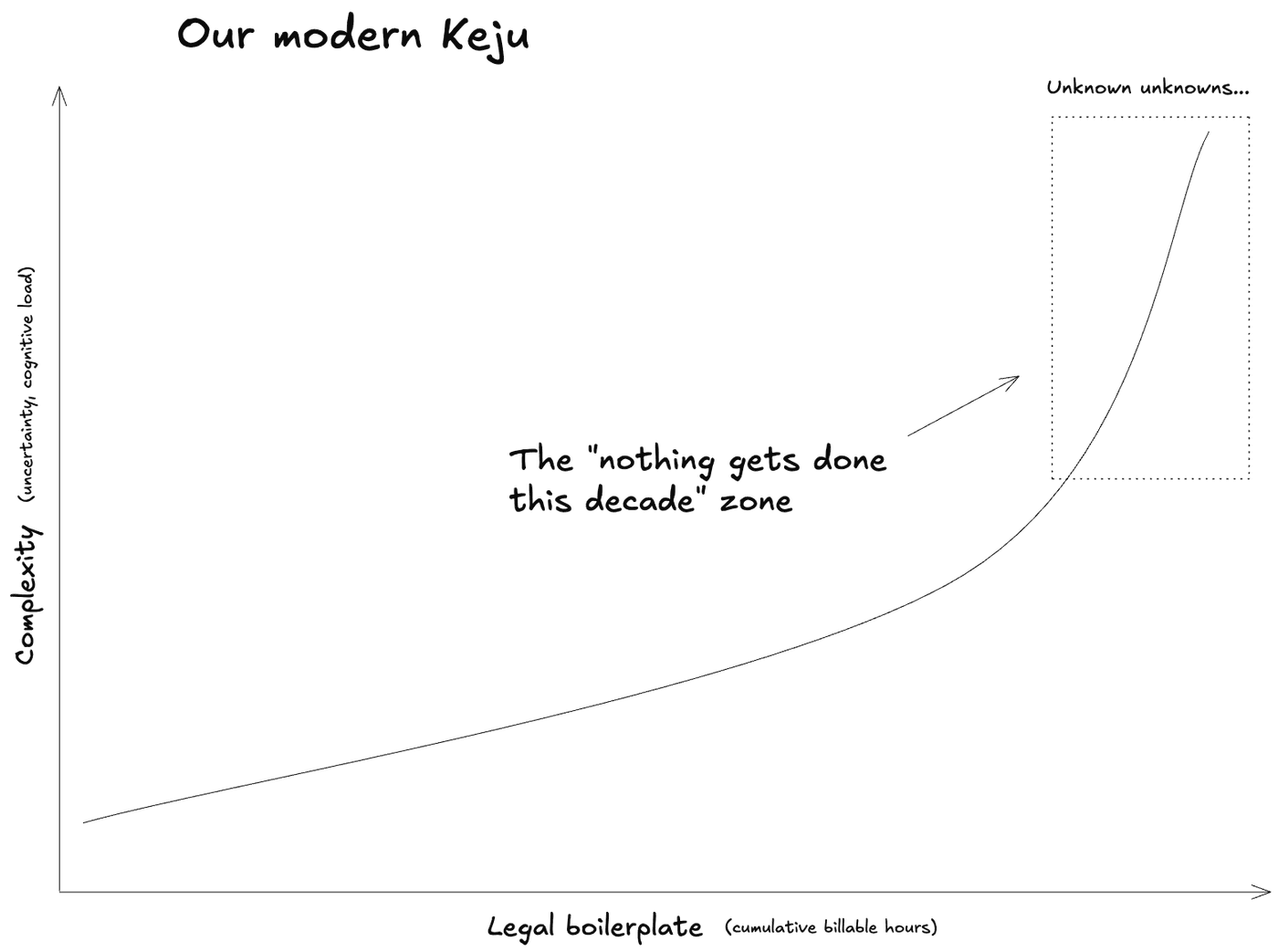
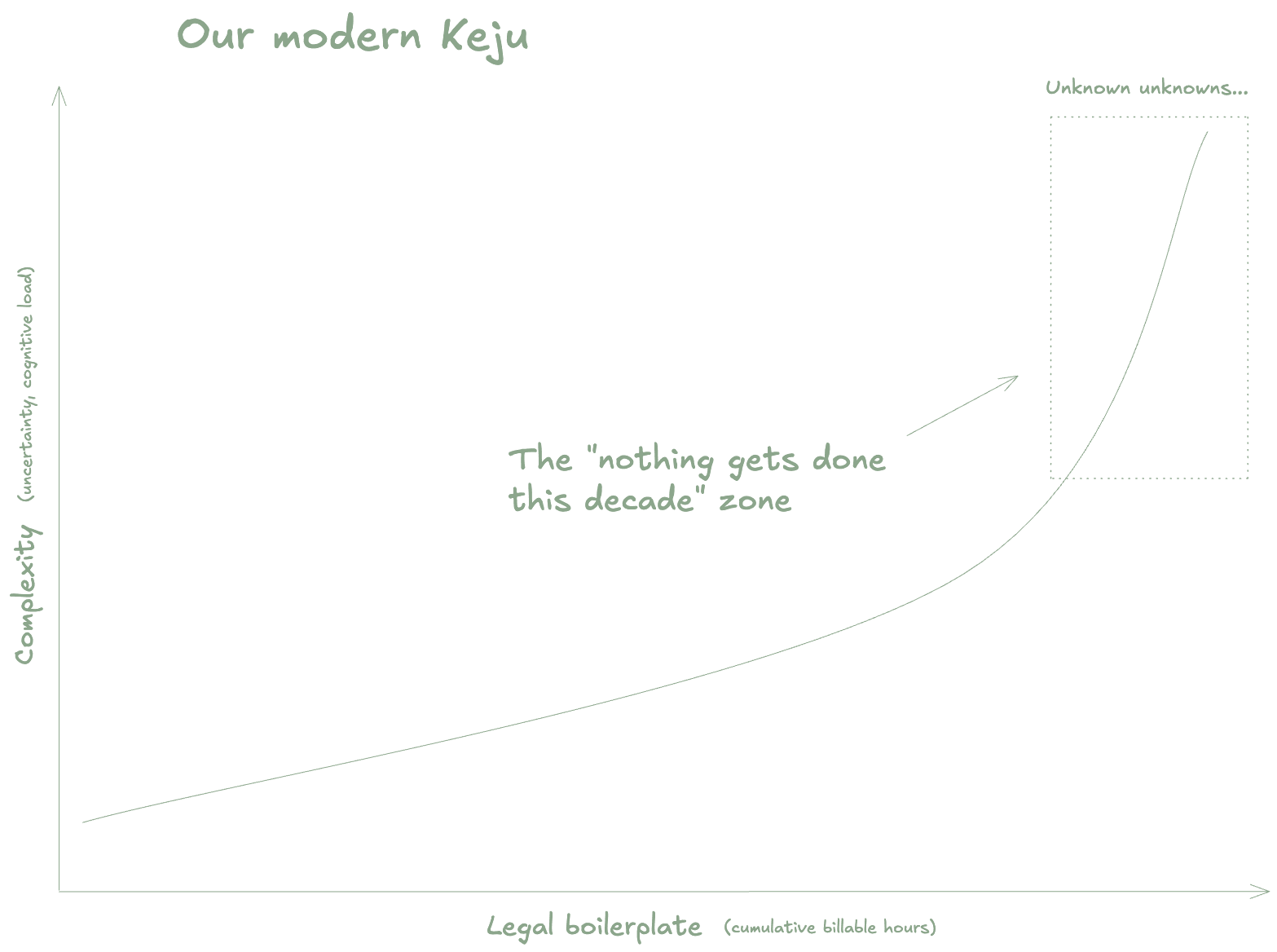
This is intended only as a qualitative illustration.
This tendency—to embed and preserve specialised complexity—runs through our modern lives. Regulatory algebra, legal boilerplate, abstract derivatives, the institutional layering of research: these are our contemporary keju. The machinery for getting anything meaningful done is now so fragmented and dense that merely navigating compliance demands an entourage of specialists. Complexity has acquired its own gravitational mass. When no single person, or even a market of people, can apprehend the indistinct whole, bad actors trivially obscure intent and deflect accountability. Every so often, decades of concealment unravel in a slew of headlines [4]. With sufficient legal tonnage and billable hours, process becomes the perfect camouflage—X papers and Y hours deep, and the trail vanishes.
This dysfunction shows up as friction: a structural slowing of real things getting done. A members-only club of process that sits outside the real economy.
We see it in public infrastructure—rail lines and power stations that become world-beating in cost and delay [5]. HS2's budget has swollen beyond reason; Hinkley Point C nuclear builds at multiples of international others. We feel it when asset prices levitate while real earnings do not [6]. UK asset prices have risen 7x since 2006, while wages have only doubled, whilst real wages have barely moved. We live it socially, in the quiet erosion of common morale and the rise of institutional distrust—a brittle uneasiness between those who can afford to navigate complexity and those who cannot.
Of course, both public bodies and private firms also produce extraordinary goods that move us forward. The problem—almost always—is the incentive stack governing behaviour within these structures. Over time, those stacks grow adept at evading sunlight, accountability, and the self-correcting feedbacks that perhaps once kept them honest.
Magna Carta was a medieval machine of fairness—a prototype that yoked power to law. The American Constitution a rights-executing system that replaced single concession with mutual coordinated constraint. Its designers engineered a game in which diverse, self-interested humans could coexist without self-destructing. Imperfect, yes; but a more robust machine that could absorb the flaws of its fallible operators.
"We, alone on earth, can rebel against the tyranny of the selfish replicators."
~ Richard Dawkins
When the act of getting things done becomes pay-to-play complexity, the machine skews toward those who can consume and wield more more of it. Perverse incentives then sustain themselves indefinitely, unmoored from any duty to improve life for others. Democratic principles carry equal capacity for self-correction and self-corruption. We tolerate systems long after they have tipped into the latter. Good governance should exert its own gravity by virtue of a far superior design, and not by a faceless bullying of due process.

Civilisation
Governance is an absolute fairness machine—a demonstrably superior way of human-to-human coordination. History seems to hint that civilisations built on such machines, however imperfect, tend to evolve towards greater prosperity and productivity with time. However, as decision-making grows more sophisticated, governance in our modern times is struggling to keep pace with sophsticated actors. Currently, adherence to process often outmanoeuvres the mechanisms intended to manage them and important systems remain tidily indistinct.
The task, then, is dull and boring: that is, to engineer better machines of fairness. To design systems whose incentive designs are fully understandable by anyone; whose internals are inspectable by default; whose complexity is fully observable; and risk extremely well understood. Good governance is a machine for making better decisions under well considered constraints—one that demands a matching sophstication with actors. Governance systems must evolve with engineering precision if we're to definitively counter the decaying nature of our prolonged coordination [7].
Footnotes
Pournelle's Iron Law of Bureaucracy: "In any bureaucracy, the people devoted to the benefit of the bureaucracy itself always get in control and those dedicated to the goals the bureaucracy is supposed to accomplish have less and less influence."
Miyazaki, Ichisada. China's Examination Hell: The Civil Service Examinations of Imperial China (1976); Elman, Benjamin A. A Cultural History of Civil Examinations in Late Imperial China (2000).
Pomeranz, Kenneth. The Great Divergence: China, Europe, and the Making of the Modern World Economy (2000); Mokyr, Joel. A Culture of Growth: The Origins of the Modern Economy (2016).
Recent examples include Wirecard's €1.9bn accounting fraud (2020), the Post Office Horizon scandal (2000s–2020s), and the 2008 financial crisis—each a case study in decades of obscured intent barreling into public view. National Health Care Fraud Takedown Results in 324 Defendants Charged in Connection with Over $14.6 Billion in Alleged Fraud - U.S. Do
The escalating cost of British infrastructure is just staggering.
HS2 cost estimates have risen from £37.5bn (2013) to over £100bn; Hinkley Point C nuclear costs approximately £35bn versus international others of £10–15bn for equivalent capacity. OECD infrastructure cost benchmarking (2021) places the UK among the highest-cost developed nations.
UK house price-to-earnings ratio increased from approximately 4:1 (1997) to 8:1 (2024), whilst real median wages have grown by less than 10% over the same period (ONS, 2024).
Banks's Culture series imagines this literally: a civilisation managed by benevolent, hyper-intelligent AIs called 'Minds' that function as perfectly ethical infrastructure—machines for fairness that optimise society for the well-being and freedom of all its citizens, eliminating want and internal conflict. It's speculative fiction, but it sharpens the question: what would governance look like if we designed it with the same rigour we apply to any other critical system?
Receive my writing to your email